
Sheriff John Larn
A Cautionary Tale

In the spring of 1876, the U.S. Army entered into a contract with the newly elected sheriff of Shackelford County, Texas, to supply beef to the garrison at Fort Griffin. The sheriff, a highly respected man who had recently married into one of the county’s leading families, was twenty-seven-year-old John Larn.
And the cattle he delivered to the troops of Fort Griffin? Larn stole every single one of them from his own neighbors.
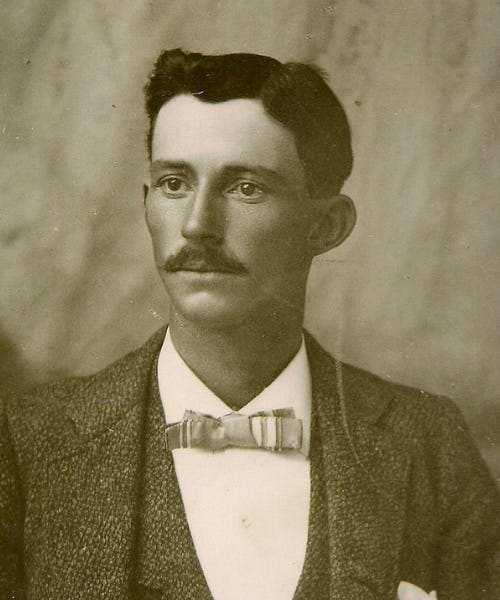
Larn was born in Alabama in 1849. He drifted west as a teenager, ended up in Colorado, and killed his employer in an argument over a horse. He then fled to New Mexico, where he killed a local sheriff he believed was tracking him.
From there, he made his way to Fort Griffin, Texas, and hired on for a trail drive back to New Mexico. Along the way, he allegedly killed three men and threw their bodies into the Pecos River to, as he put it, feed the catfish. Whether he actually said that, or it was attached to him later on by a writer with an overactive imagination, is unclear.
When Larn got back to Fort Griffin, he had a falling out with the trail boss and led a few disgruntled drovers on a rampage throughout the camp. Two men were killed, and seven were wounded. Word got around that the dead men had been rustling cattle, so nobody pressed the issue.
Eventually, Larn began transforming himself into something resembling a respectable citizen. Or I guess I should say he attempted to transform himself. He hired on as foreman for rancher Bill Hays, but sadly, the violence continued. As evidenced by Larn allegedly killing three men (including a shepherd) during a cattle drive to Colorado.
I don’t know about you, but I think I’m starting to see a pattern. Even by frontier standards, the body count was really starting to add up. Still, though, Larn was either charming enough or capable enough that the killings weren’t pursued.
Skip ahead to 1872, and he was wed in holy matrimony to Mary Jane Matthews, the younger sister of cattleman John Alexander Matthews, and in doing so married right into the local establishment.
By 1873, the first allegations of cattle stealing surfaced. That same year, Larn rode with a posse and thirteen soldiers from Fort Griffin and ambushed Bill Hays’s entire cattle outfit near Bush Knob in Throckmorton County. Every member of the outfit was killed.
In 1874, he joined the Tin Hat Brigade, a local vigilance committee. Horse thieves all of a sudden began dangling from trees along the river, but Larn still somehow managed to get elected sheriff of Shackelford County in April of 1876.
Almost immediately, he secured a contract with the army garrison at Fort Griffin to deliver three steers a day. He brought in his old friend John Selman as a deputy (yikes!), and the two of them began fulfilling the contract. The only problem was where the cattle were coming from. You see, Larn had his own herd, but apparently, he preferred cows that belonged to his neighbors. Ranchers around Shackelford County started to notice that their cattle were disappearing while Larn’s weren’t. By March of 1877, the scheme was exposed, and Larn was forced to resign.
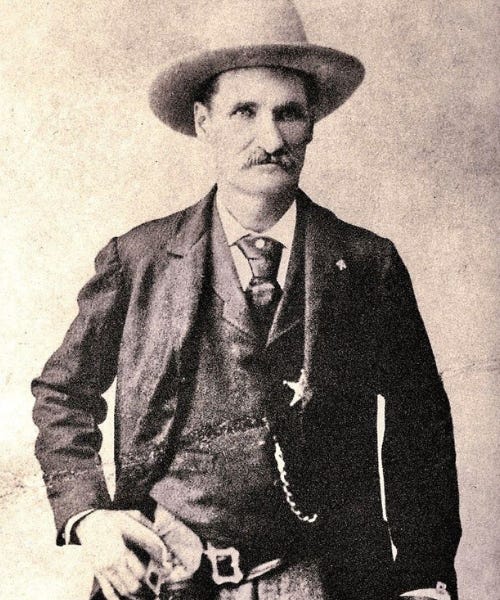
Surprisingly, no charges were filed.
What’s more, Larn and Selman were then appointed as deputy hide inspectors for the county. In other words, they were responsible for inspecting all cattle entering and leaving Shackelford and supervising local butchers. Putting these two in charge of the hide inspection was a little like asking the fox to guard the henhouse. The rustling continued, and so did the violence.
Finally, in February of 1878, a civilian posse got a warrant and searched the river behind Larn’s house. After pulling six stolen hides from the water, Larn was arrested, taken to Fort Griffin, and…
Released!
Guess what? The violence continued.
On June 22, 1878, Larn shot and wounded a local rancher named Treadwell, who had supposedly been the one to uncover the rustling. Later on that same day, Larn was arrested by his successor, Sheriff William R. Cruger. I reckon Cruger had no intention of letting Larn walk out of the jail he used to run, so he took him to the county seat at Albany and had the local blacksmith shackle him to the floor of the jail to prevent an escape.
And the shackles worked. Not only did they prevent Larn from escaping, but they also kept him put when the vigilantes arrived.
You see, at midnight on June 23, a mob of masked men overpowered the guard. They tried to drag Larn out for a proper hanging, but the blacksmith’s work held, so instead they shifted to Plan B: They formed a firing squad right there inside the cell and shot Larn where he sat.
He was twenty-nine years old.
Unfortunately for humanity, John Selman (Larn’s old partner) slipped away before the vigilantes could get their hands on him. He slinked west and eventually ended up in El Paso, where in 1895 he would shoot John Wesley Hardin in the back of the head at the Acme Saloon. Selman would meet the same fate himself less than a year later at the hands of Deputy Marshal George Scarborough.
I guess the good Lord meant it when he said that those who live by the sword die by the sword.
UPDATES
There will not be a new episode of The Wild West Extravaganza this week. Everything is going great, but I’m working on several different projects, and they still need a few finishing touches. It’s also my daughter’s pre-school graduation. Can you believe she’s almost 5 years old? She just passed her second martial arts belt test and had a dance recital, so we’ve been pretty busy!
I do have one thing you might enjoy, though, in lieu of new content. I’m calling it the Which Gunfighter Would You Be Personality Quiz.
So, if today’s story made you wonder which Old West character you’d have been (and hopefully not John Larn), I built a quiz for exactly that. Twelve questions, two minutes, and you’ll find out which gunfighter, lawman, or outlaw you most resemble.
Click here to take the quiz. It’s 100% free. And if you like your results, you even have the option to share on social media.
Alright, till next time,
Adios.
A great read - now following. And on the quiz, Tom Horn….
Vicious thug this one, and only 29, a numbing run of murder and mayhem.