
The Blackfoot Scout and the Samurai Sword
How Japanese katanas ended up in the hands of Native American Warriors

In the spring of 1894, an English-born photographer named Norman Caple set up his equipment on the windswept plains outside Gleichen, Alberta, and took a picture that has puzzled historians for over a century.
His subject was a Blackfoot scout named Dog Child, aka Winnipeg Jack, who was employed by the North West Mounted Police. Standing beside Dog Child was his wife, The Only Handsome Woman, draped in a fringed buffalo hide dress with a heavily beaded shawl. Behind them was a tipi, and off to one side, a horse waited patiently. Everything in the frame made sense except for the object held loosely in Dog Child’s right hand: a Japanese katana.
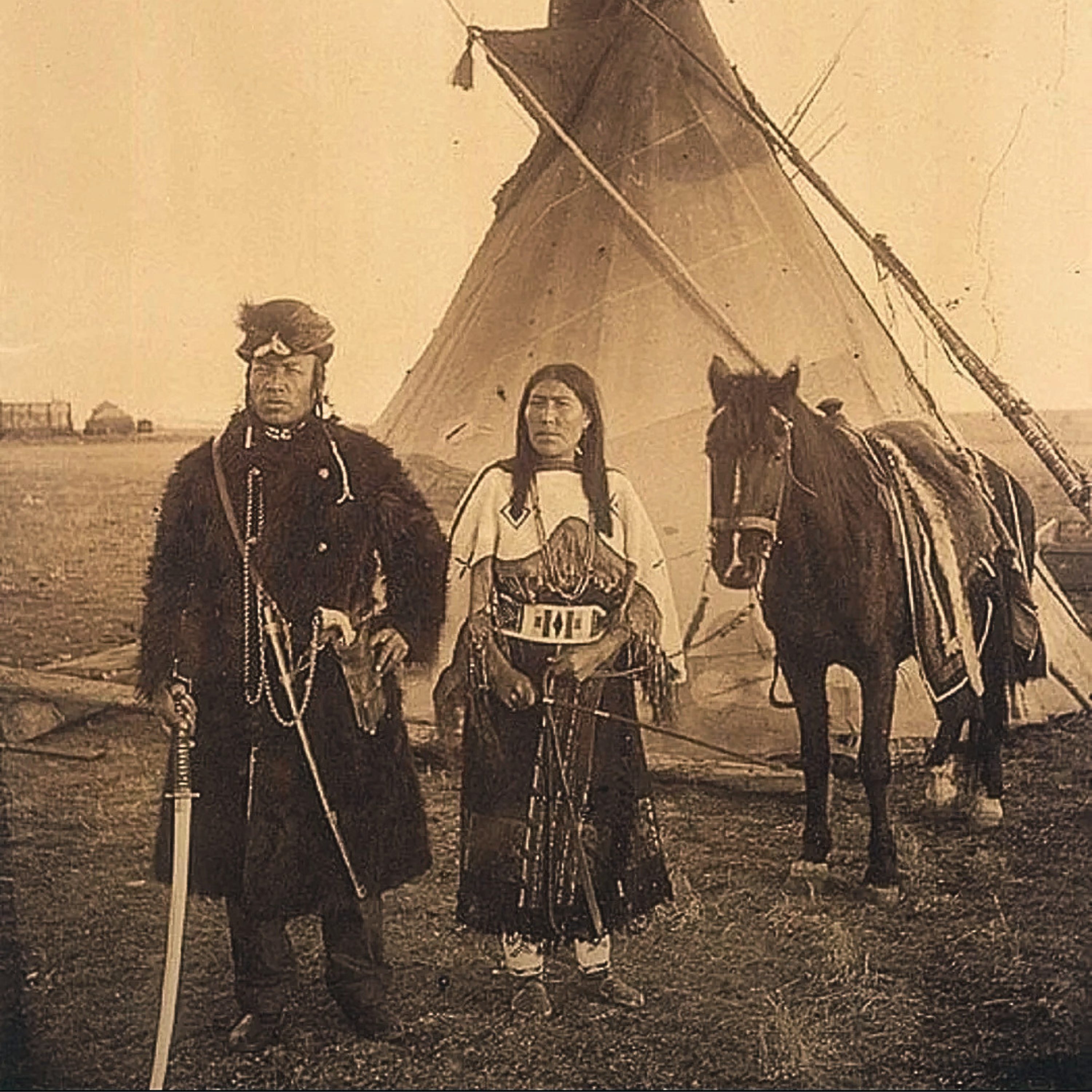
As an NWMP scout, Dog Child’s primary role was to locate horse thieves trafficking in stolen stock across the U.S.- Canada border. He shows up on Blackfoot Band Annuity pay lists from 1896 to 1898, but no birth date or biography accompanies the entries. Equally as mysterious is how exactly he got his hands on such a blade. There are theories, though.
By the mid-1800s, Japan had ended its long period of self-imposed isolation, largely at the insistence of Commodore Matthew Perry and his naval fleet. In the years that followed, Japanese diplomats began arriving in American cities, and the katana became a favored instrument of goodwill. As such, the swords were often gifted to everyone from Secretaries of War to heads of state, and even to the Smithsonian.
The Most Likely Explanation?
Historian Peter Bleed, writing in 1987, put forward the most plausible theory for how the sword reached Dog Child.
An Anglican missionary named Reverend Canon Stocken had been assigned to the Blackfoot community in Gleichen in 1895. Before taking up the post, Stocken traveled to Japan to marry his second wife, Gertrude Cox, who had herself been a missionary there. The couple returned to Alberta together, and it is entirely possible (albeit unconfirmed) that they brought the sword back with them, where it eventually made its way into Dog Child’s possession through gift or trade.
Then again, the photo was taken in 1894, and Stocken didn’t arrive in Gleichen until 1895. The plot thickens!
What about the photographer? Could the sword have just been a prop? Maybe, but then again, Caple was apparently known for his uncompromising realism and his habit of photographing his Indigenous subjects without staging or props. If a sword appears in Caple’s photo, it was almost certainly because the sword was genuinely there, in the hands of its owner.
Dog Child Was Not Alone
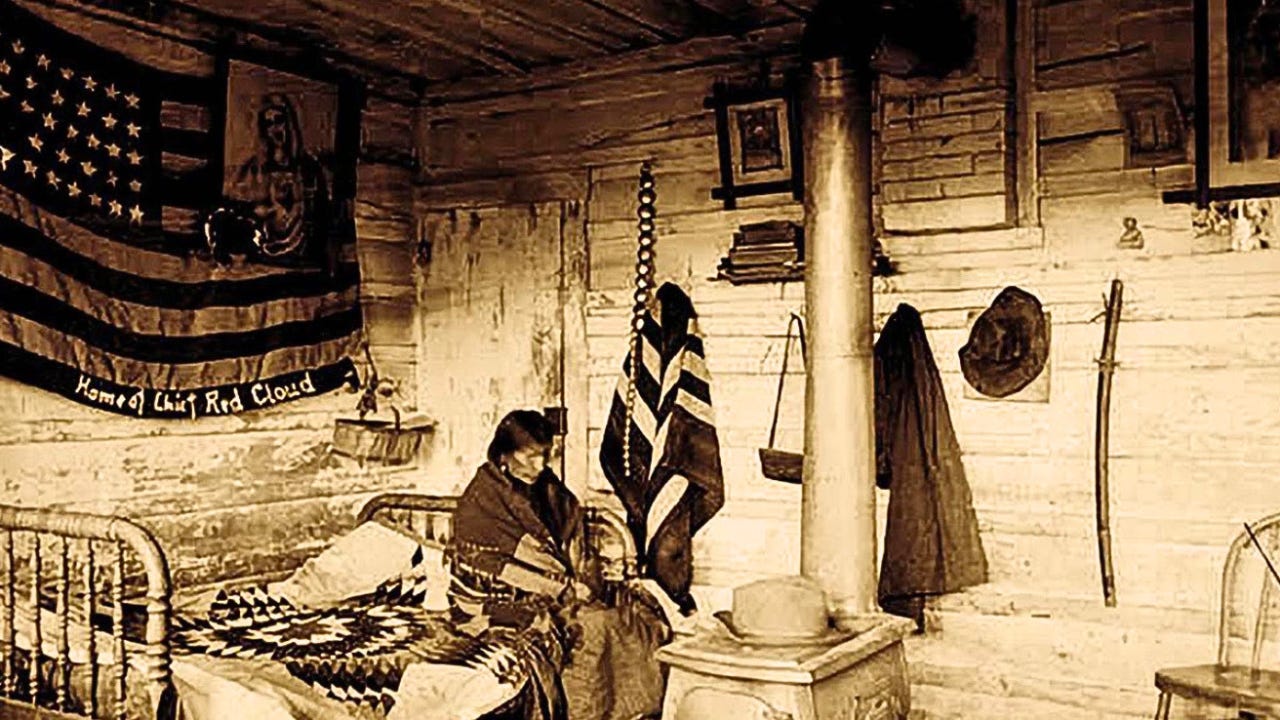
What makes the photograph all the more striking is that it’s not the only known instance of a Native American owning a katana. Researchers have identified at least one other documented case of a 19th-century Indigenous leader in possession of a Japanese blade: Oglala Lakota Chief Red Cloud, photographed in 1890 with a katana hanging on the wall of his home at Pine Ridge Reservation, South Dakota.
A 2019 academic paper examined both images together, concluding that the phenomenon was not a pure coincidence and that the diplomatic and trade networks of the era were more than capable of carrying Japanese steel deep into Indigenous North America.
This does actually make a lot of sense. If I’ve learned anything researching the Old West, it’s that the frontier was far more connected than we tend to imagine.
Unfortunately, Dog Child’s katana has never been located. No trail of provenance, no museum records, and no family accounts lead to its current whereabouts. The man himself fades from the record after 1898, and his wife, The Only Handsome Woman, is remembered only through Caple’s lens.
Either way, I thought it was pretty cool and thought I’d share it with you. Who knows, maybe the movie Shanghai Noon wasn’t entirely fictional…only, instead of Jackie Chan coming out on top, it was our man Dog Child.
Love this article. I have black foot ancestry and I am samurai.
Oh for that fancy DeLorean to back into this photo shoot...